• ZINO Consultadoria
  • Our services
    • Consultancy >
      • Marketing and Promotion
      • Startup Madeira
      • Tax Advice
      • Mosquito Aedes aegypti >
        • Mosquito Monitoring Programme >
          • Mosquito Monitoring Programme - store
        • Biogents units - mosquito traps >
          • Mosquito Traps - store
        • Mosquito Aedes aegypti blog
    • Agriculture
  • About
    • Contacts
  • Blog
  • Norwegian Honorary Consulate
  ZINO Consultadoria

Aedes aegypti mosquito update

Aedes aegypti mosquito, the vector for Dengue, Chikungunya and Zika vius
Monitoring Programme with Biogents mosquito traps help control the mosquito population.

CONTACT FOR INFORMATION

Funchal City Council update on fight against Dengue mosquito vector

5/4/2013

0 Comments


Funchal City Council "Camâra Municipal do Funchal" update on the fight against Aedes aegypti mosquito, Dengue virus vector

Press conference to update on actions being put in place to continue the fight against Aedes aegypti mosquito, the Dengue fever vector.

More information on the dedicated area "todos constra o mosquito" which also has a section to report potential breeding sites.
0 Comments

Madeira Dengue Fever outbreak update - 14 February 2013

14/2/2013

0 Comments

 
Picture
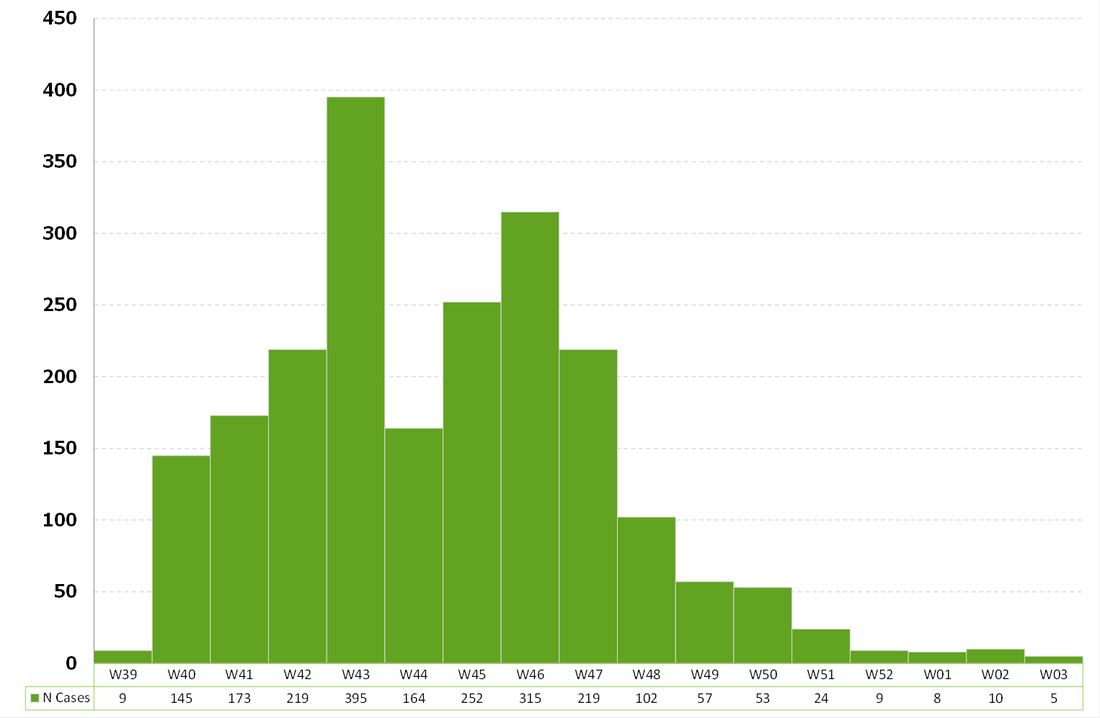
Weekly number of dengue case from week 39/2012 to week 3/2013 - Probable and confirmed cases, n=2 164 excluding imported cases in the EU
Source: ECDC - 14 Feb. 2013
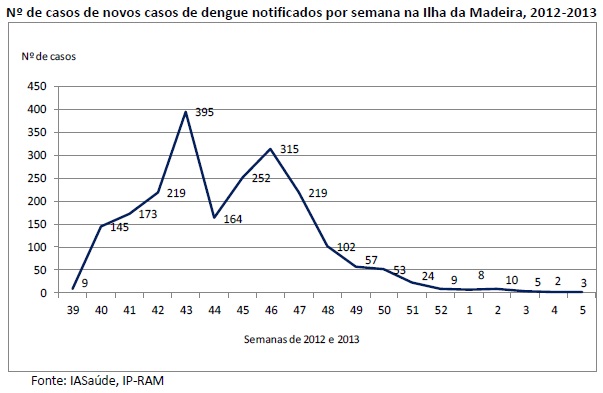
The latest figures from the Portuguese Ministry of Health indicate an important decrease of the number of notified cases reported since mid-November 2012, week 46 (see the 'Situação em 03/02/2013' update on the Dengue fever page of the Direção-Geral da Saúde website) - as reported in previos post on this blog. However, the outbreak is still on-going with 28 cases reported in 2013 and three cases last week recorded by the local epidemiological surveillance system. This is indicative of an uninterrupted transmission occurring since the start of the outbreak and continuous vector activity. In addition, based on retrospective information on vector surveillance and meteorological data, the seasonal increase of vector activities will likely take place from around May-June 2013.
 ECDC advises residents and travellers visiting the island of Madeira to take individual protective measures (like using repellents) to avoid mosquito bites. Dengue is transmitted by a daytime mosquito and consequently protective measures must be applied throughout the day. Travellers experiencing febrile symptoms with severe headache, retro-orbital pain, myalgia, arthralgia and maculo-papular rash within 21 days of visiting Madeira are advised to seek medical advice.

ECDC continues monitoring the situation in collaboration with National and regional (Madeira) public health authorities in Portugal and gathering information on confirmed cases reported by EU/EEA Member States among returning travellers.

Source: ECDC Epidemiological update: Outbreak of dengue in Madeira, Portugal, 14 Feb 2013
0 Comments

Madeira Dengue Fever - number of new weekly cases reported in local population continue to drop

12/2/2013

0 Comments

 
Picture
Madeira Dengue cases reported in local population continue to drop. Source: DGS report 3 February 2013

New Madeira Dengue cases reported per week in local population continue to drop

Since the start of the Dengue outbreak in Madeira on 3rd October 2012, a total of 2164 Dengue fever cases have been reported in the Autonomous Region of Madeira health network, with new number of reported cases per week in local population continuing to drop.

Exported cases of Dengue Fever

Picture
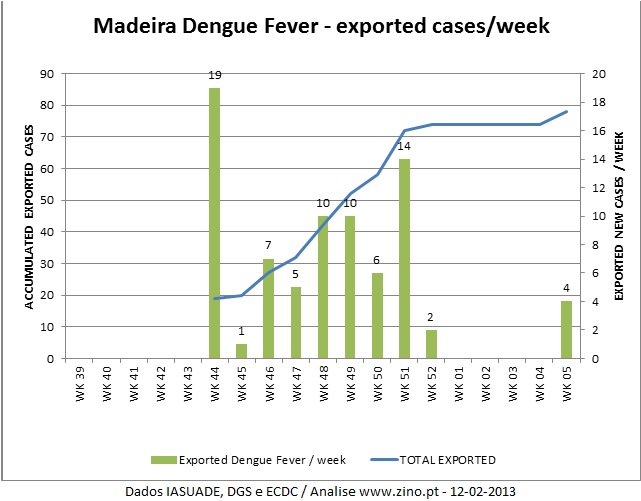
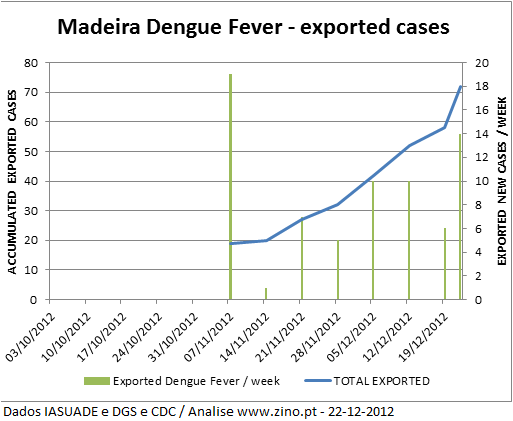
Madeira Dengue Fever - exported cases. Analysis www.zino.pt
NOTE: reporting is monthly, so possible that exported cases could have occurred since previous report issue rather than a significant outbreak.

Total number of exported cases has increased from 74 to 78 since the last monthly report in January 2013, with one new case reported in Portugal and three in Finland. The last report was on 1st February 2013 (ECDC - CDTR report week 6).

No travel restrictions to and from Madeira maintained and preventative measures still recommended.

Although the number of new local Dengue Fever cases reported per week continue to drop (due to reduced mosquito population activity because of lower temperatures), dengue still exists in the vector Aedes aegypti mosquito in Madeira, as the new cases confirm. Health authorities maintain the recommendation of prevention measures to avoid getting bitten by mosquito.

Dengue Fever mosquito Monitoring Programme

We maintain developing the Aedes aegypti Mosquito Monitoring Programme which will allow participants to monitor mosquito eggs and larvae as well as adult mosquito population and, according to weekly results, take preventative measures to avoid adult mosquito outbreaks and consequent Dengue Fever transmission/outbreak.
The Aedes aegypti Mosquito Monitoring Programme can also include a site visit and audit to identify potential mosquito breeding sites and recommend actions to reduce or eliminate breeding sites as well as regular audits to verify implementation of recommendations.

We are working with the Chamber of Commerce and local  authorities to develop a network of participants who want to monitor their own private areas, which can complement the monitoring network being done by local authorities.
contact - MOSQUITO MONITORING PROGRAMME
Sources:
  • DGS report 3 February 2013
  • ECDC Communicable Disease Threats Report (CDTR) - week 6/2013 - 12 February 2013
2013-02-03_dgs_i018334.pdf
File Size: 282 kb
File Type: pdf
Download File

2013-02-12_ecdc_communicable-disease-threats-report-9-feb-2013.pdf
File Size: 268 kb
File Type: pdf
Download File

0 Comments

Mosquitaire traps recommended by the European Centre for Disease Prevention and Control (ECDC)

4/2/2013

0 Comments


Biogents Mosquitaire traps recommended as most efficient for Dengue vector mosquitoes: Aedes aegypti and Aedes albopictus

Picture
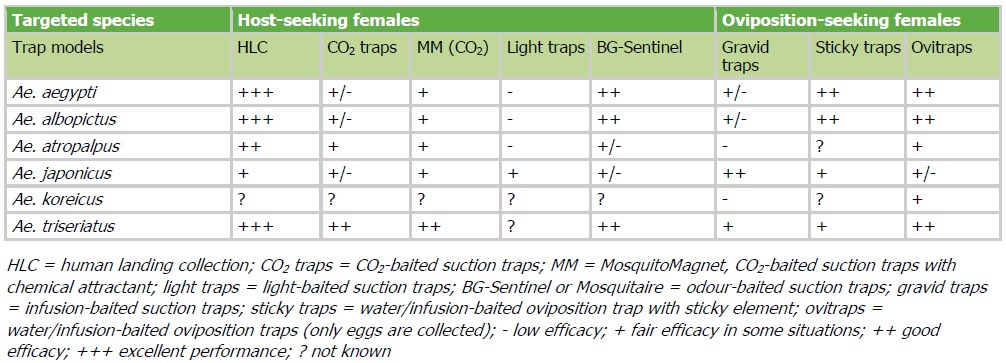
Methods of collection of IMS (invasive mosquito species) adult or detection by egg collection and their efficacy according to mosquito species. SOURCE: ECDC Guidelines for the surveillance of invasive mosquitoes in Europe
The ECDC have released a Technical Report "Guidelines for the surveillance of invasive mosquitoes in Europe" which can be consulted below.

Once again, our selected Biogents Mosquitaire mosquito traps have been recognised as most efficient at capturing Dengue vector mosquitoes Aedes aegypti and Aedes albopictus after "human landing collection", a process which must be used only if there is no evident risk of transmission during the mosquito bite / blood meal - this is therefore not recommended in Madeira!

Aedes aegypti Monitoring Programme

The Aedes aegypti Monitoring Programme aims to monitor both mosquito population with Ovitraps (egg and larva) as well with Biogients Mosquitaire mosquito traps (adult mosquito population).
All partners participating in the monitoring programme will not only demonstrate that they are being proactive with regard to the Dengue mosquito vector, but also be better informed and better prepared to take further actions to reduce mosquito population and consequent reduction in the possibility of of being bitten as one of the strongest recommendations regarding Dengue virus remains "preventative measures from getting bitten".

For all those interested in participating in the monitoring programme, please use the following contact form.
ecdc_ter-mosquito-surveillance-guidelines.pdf
File Size: 6102 kb
File Type: pdf
Download File

0 Comments

ECDC - Communicable Disease Threats Report (CDTR) - week 3 - 13 to 19 January 2013.

18/1/2013

0 Comments


Madeira Dengue Outbreak coming to an end with reduced mosquito activity 

The last ECDC report of 18 January 2013 indicates that no more local cases have been reported since 6 January 2013 and no more cases have been reported by visitors after returning from Madeira as of 3 January.

We have extracted the key summary points from the last ECDC report below.

Local and the Portuguese national health authorities are only issuing monthly reports, but there is an ongoing monitoring program by the local health authorities.

Monitoring Programme
ZINO - Consultadoria, in partership with ITB are also proposing a monitoring program for private individuals and enterprises, which will not only allow monitoring of mosquito activity in participants "back yard", but also recommend actions in line with best international practises, including preventative measures (mosquito nets, cleaning of breading grounds, etc) as reactive measures (increase use of mosquito traps, chemical treatments, etc) - interested parties can visit this page and contact us directly for more information.

There is no new update this week on the number of autochthonous dengue cases in Madeira. As of 6 January 2013, 2.144 cases of dengue infection have been reported.
As of 17 January 2013, 74 patients have been diagnosed with dengue after returning from Madeira: 10 in Portugal, 23 in the UK, 19 in Germany, three in France, five in Sweden, four in Finland, two in Denmark, two in Austria, and two in Norway. Croatia, Slovenia, Spain and Switzerland have all reported one case each. The last reported case was on 3 January 2013.
The updated figures indicate that the outbreak has peaked, with a decrease in the number of cases being reported since mid-November. Entomological surveillance has shown a decrease in mosquito activity as well.
The cases of dengue among returning travellers from the island highlight the need for travellers to Madeira to take measures in order to reduce mosquito bites. Travellers experiencing febrile symptoms with severe headache, retro-orbital pain, myalgia, arthralgia and maculo-papular rash within 21 days of visiting the island of Madeira are advised to seek medical advice.
The epidemiological situation does not imply the need for any trade or travel restriction beyond the disinfestation policies currently implemented.
Source: ECDC
2013-01-18_ecdc_communicable-disease-threats-report-19-jan-2013.pdf
File Size: 269 kb
File Type: pdf
Download File

0 Comments

ECDC - Communicable Disease Threats Report (CDTR) - week 2 - 11 January 2013.

13/1/2013

0 Comments

 
Picture
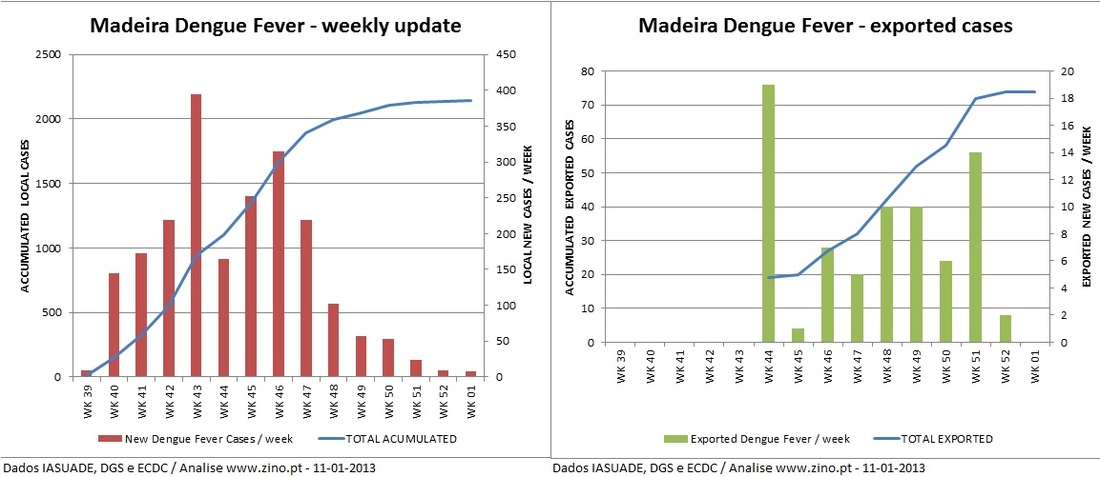
There is an ongoing outbreak of dengue in the Autonomous Region of Madeira, Portugal, ... , with some imported cases reported from other EU Member States. Since the beginning of the outbreak, 2 144 cases of dengue infection have been reported from the public health sector in Madeira.
The vast majority of confirmed cases are from the city of Funchal, which is the main port on Madeira island. The island of Madeira has an established mosquito population of Aedes aegypti, the main vector of dengue in tropical and subtropical countries.
As of 9 January 2013, 74 patients have been diagnosed with dengue after returning from Madeira: 10 in Portugal, 23 in the UK,19 in Germany, three in France, five in Sweden, four in Finland, two in Denmark, two in Austria, and two in Norway. Croatia,Slovenia, Spain and Switzerland have all reported one case each. The latest case was reported on 3 January 2013.
No autochthonous cases were reported in other European countries in 2012 and at the start of 2013.
The epidemiological situation does not imply the need for any trade or travel restriction beyond the disinfestation policies currently implemented. 
Sources: IASaúde, DGS, ECDC
At this time, CDC does not advise against travel to Madeira. However, travelers should protect themselves from mosquito bites.
Source: Travel Health Assist, 13 Jan 2013 and CDC - Outbreak Notice, 16 Jan 2013
2013-01-06_dgs_i018199.pdf
File Size: 293 kb
File Type: pdf
Download File

2013-01-11_ecdc_communicable-disease-threats-report-11-jan-2013.pdf
File Size: 344 kb
File Type: pdf
Download File

0 Comments

ECDC - Communicable Disease Threats Report (CDTR) - week 1 - 4 January 2013.

4/1/2013

0 Comments

 
As of 16 December, 2 103 cases of dengue infection have been reported in Madeira. The Portuguese health authorities are now publishing updates on the number of dengue cases in Madeira every month.
Between 20 December 2012 and 3 January 2013, there was an increase of 2 exported cases (patients diagnosed with dengue after returning from Madeira): one in the UK and one in Germany, bringing the total of exported cases to 74. The ECDC state that it is possible that there is an under-reporting of exported cases due to the holiday period.

The ECDC maintain their statement that there is no travel restriction to and form Madeira as well as the recommendation to take preventative measures to avoid mosquito bites.
The epidemiological situation does not imply the need for any trade or travel restriction beyond the disinfestation policies currently implemented. 
Source: ECDC CDTR week 1, 4 Jan 2013
2013-01-04_ecdc_communicable-diseases-threats-report-4-jan-2013.pdf
File Size: 313 kb
File Type: pdf
Download File

0 Comments

5 talks about mosquitos - and how to stop their buzzing

3/1/2013

0 Comments

 
Hadyn Parry, CEO of Oxitec gives a great TED series talk "5 talks about mosquitos-and how to stop their buzzing" about the control of Aedes aegypti mosquito, vector of Dengue.

The world’s most dangerous animal isn’t the lion, tiger or bear. It’s actually the mosquito.

“Mosquitos have killed more humans than any other creature in human history,” says Haydn Parry in today’s talk. “The mosquito has killed more humans than wars and plague.”

Every year, about a million and a half people succumb to malaria — even with technologies to prevent and treat the disease — while 50 to 100 million people a year are infected with dengue fever, a disease sometimes called “breakbone fever” that has grown 30 fold in the last half century. Spread by a species of mosquito from northern Africa — Aedes aegypti — the disease has sky rocketed because this mosquito and its eggs are so good at hitch hiking as human beings travel the world.

Traditionally, there have been two ways to control mosquitos in addition to nets and wearing covering clothing — larvicides, which kill mosquito eggs, and a variety of products designed to kill mosquitos as they fly. Both options are, however, difficult to deploy and can damage the environment, not to mention harm humans. Meanwhile, a single female mosquito can lay 500 eggs in her lifetime.

Parry’s company, Oxitec, has an idea to stop the rapid spread of dengue fever: genetically engineering male mosquitos to make their offspring unviable.

“There are two features of mosquito biology that really help us. Firstly, males don’t bite,” explains Parry. “And second — males are very, very good at finding females.  If there’s a male mosquito that you release and there is a female around, the male will find the female … If that male is carrying a gene that causes the death of the offspring, then the offspring don’t survive. Instead of having 500 mosquitos running around, you have none.”

Parry shares that small initial field trials of this method show that, in as short as four months, a mosquito population can be depleted by as much as 85%. If further research goes well, these altered mosquitos can be shipped, cheaply, around the world.

To hear more about this promising approach, watch Parry’s talk above. And after the jump, see four more talks on mosquito madness.

0 Comments

ECDC - Communicable Disease Threats Report (CDTR) - week 52 - Portuguese health authorities announced that they will cease to publish regular updates.

29/12/2012

0 Comments


ECDC CDTR for week 52, 23 - 29 December 2012

There has been no evolution of reported cases of Dengue Fever in local or visiting tourists (exported cases) population since last week´s report as the Portuguese health authorities announced that they will cease to publish regular updates regarding the number of dengue cases in Madeira, even after the ECDC in their report on 13 December 2012 alerted to the expected increase in cases until the end of the mosquito season in January 2013 and increased population over the Christmas and New Year season by visiting tourists as Madeira is a popular holiday destination.

ECDC maintain the following statement regarding travel to and from Madeira, as well as suggesting preventative measures form getting bitten by mosquito.
The epidemiological situation does not imply the need for any trade or travel restriction beyond the disinfestation policies currently implemented.
2012-12-28_ecdc_communicable-disease-threats-report-28-dec-2012.pdf
File Size: 310 kb
File Type: pdf
Download File

0 Comments

ECDC - Communicable Disease Threats Report (CDTR) - week 51 - Growing Number of Exported cases of Dengue

22/12/2012

0 Comments

 
Picture

Madeira Dengue outbreak reducing amongst locals but increasing amongst vistors to the island

Whilst the reported cases of Dengue Fever amongst the local population reported on 19-12-2012 by local and national health authorities were reconfirmed by ECDC´s CDTR of week 51 issued 22-12-2012, the same report increased the number of reported exported cases from 58 to 72 until 20 December 2012.

Health authorities  including the European ECDC and US CDC maintain that there are no travel restrictions to Madeira. Visitors should take preventative protection measures (use mosquito relent containing DEET, use long sleeves shirts and trousers) to prevent getting bitten.
The epidemiological situation does not imply the need for any trade or travel restriction beyond the disinfestation policies currently implemented. 
Source: ECDC CDTR, week 51 (16 - 22 December 2012)
Analysis: ZINO - Consultadoria
2012-12-21_ecdc_communicable-disease-threats-report-21-dec-2012.pdf
File Size: 547 kb
File Type: pdf
Download File

0 Comments
<<Previous
Forward>>
    BLOG home page

    Monitoring Programme

    We are proposing an Aedes aegypti Monitoring Programme for private individuals and enterprises - find out more. 

    Mosquito traps
    Mosquito Aedes aegypti

    Picture
    Dengue, Chikungunya and Zika mosquito traps

    Andrew Zino

    Licenciado em Micro Biologia de Medicina pela Universidade de Edimburgo (BSc Hons), após pesquisa, identifica em 2008 as armadilhas Biogents com prova cientifica da sua eficácia.

    View my profile on LinkedIn

    Sources

    • WHO
    • CDC Travel Notice / Madeira
    • ECDC
    • INSA
    • DGS
    • IASUADE

    Archives

    May 2016
    February 2016
    January 2016
    October 2014
    September 2014
    July 2014
    March 2014
    April 2013
    February 2013
    January 2013
    December 2012
    November 2012
    October 2012

    Categories

    All
    Aedes Aegypti
    Aedes Albopictus
    Chikungunya
    Combate Quimico
    Den 1
    DEN-1
    Dengue
    Ecdc
    Febre De Dengue
    Funchal
    Madeira
    Mosquito
    Outbreak
    Travel

    RSS Feed

Powered by Create your own unique website with customizable templates.